
I’ve been a little quieter on LinkedIn recently.
Sometimes that’s exactly what leadership demands.
When time is limited, you can’t give everything equal attention. You have to decide what matters most, and for the last six weeks, my focus has been firmly on the day job.
Our business has ambitious growth plans.
Like many organisations, we started by looking for opportunities to improve. There were plenty of sensible suggestions, a few quick wins and several “nice to haves.”
But something didn’t sit right with me.
I felt we were avoiding the difficult conversations.
The ones that genuinely determine whether a business can move to the next level.
We’d normalised waste in our everyday operation.
Shift handovers where nothing happened.
Huge overlaps where capacity wasn’t being used effectively.
Decisions based on yesterday’s data instead of what was happening right now.
These weren’t new problems.
They’d simply become accepted as “the way we’ve always done it.”
Then came all the familiar reasons why nothing could change.
“It can’t be done.”
“You’ll upset everyone.”
“People will leave.”
“The union won’t agree.”
If you’ve been in leadership long enough, you’ve heard them all.
But at some point you have to ask yourself a simple question:
Are these facts, or are they assumptions we’ve repeated for so long they’ve become accepted as truth?
So we made the decision to be brave.
We redesigned the shift pattern.
We introduced live visual management across the factory so decisions could be made in the moment instead of analysing yesterday’s problems.
It wasn’t easy.
In fact, the last six weeks have been some of the hardest I’ve experienced.
Changing long-established ways of working never is.
We’ve uncovered problems we never knew existed.
We’ve challenged habits that had become invisible.
We’ve discovered talented people who were previously hidden by inefficient processes.
But we’ve also seen something else.
Zero people have left.
The new shift pattern has been well received.
People can plan their lives better.
Expectations are clearer.
The factory has greater visibility of what’s happening in real time.
Most importantly, the whole team is pulling in the same direction.
Looking back, I realise something else has changed.
A few years ago, I don’t think I’d have had the confidence to lead something this significant.
I’d probably have accepted the reasons why it couldn’t be done.
Experience has taught me that the biggest constraint in most organisations isn’t technology.
It isn’t investment.
It isn’t capability.
It’s the stories we tell ourselves about why change is impossible.
Sometimes leadership isn’t about finding another quick win.
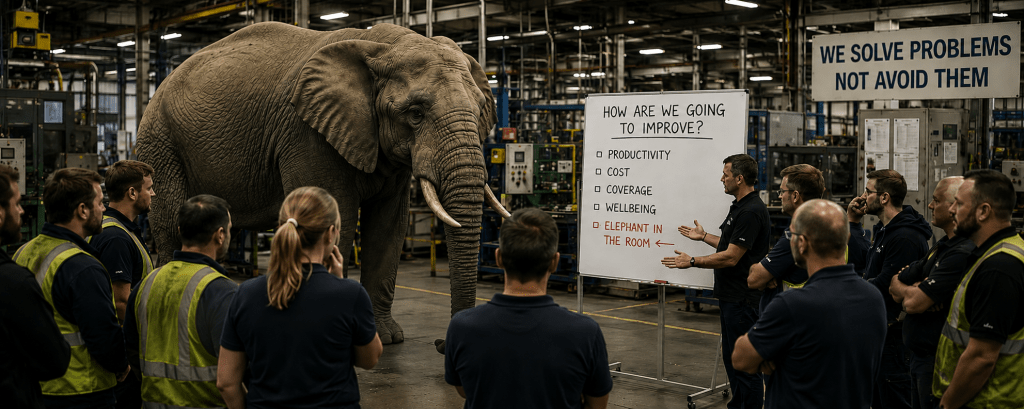
Sometimes it’s about having the courage to tackle the elephant in the room.
So I’ll leave you with this…
If you could change one thing in your organisation tomorrow, what would it be?
And perhaps the more important question…
What’s really stopping you?


Leave a comment