
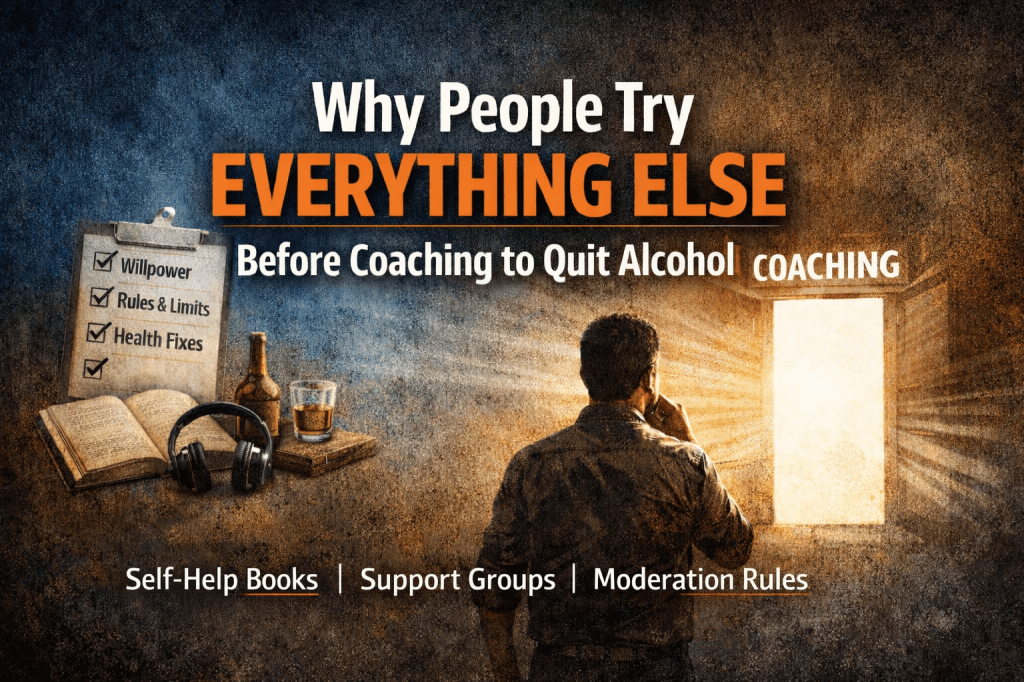
If you’re a high performer thinking about giving up alcohol, coaching is almost never the first option.
By the time someone reaches out, they’ve usually tried everything else, many time over.
Here’s what typically comes before coaching;
1. Willpower
This is always the starting point.
“I’ll just stop.” “I’ll be more disciplined.” “Plenty of people drink less than me.”
For high performers, effort feels like the solution to everything.
Until stress, fatigue, or pressure hits, and willpower disappears.
Alcohol isn’t a motivation problem. It’s a stress and habit system problem.
2. Rules, Limits & Moderation
Next comes structure.
• Only at weekends • Two drinks max • No drinking during the week • Tracking apps
On paper, it makes sense.
In reality:
- Alcohol weakens the part of the brain enforcing the rules
- Moderation creates constant decision fatigue
- Every evening becomes a negotiation
Relief never arrives.
3. Health-Driven Attempts
Often triggered by a warning sign:
• Poor sleep • Weight gain • Blood pressure • GP comments • Declining energy
So they cut back. Temporarily.
But health data alone doesn’t rewire habits, especially when alcohol is still the fastest way to switch off after work.
They already know it’s bad for them. Knowing isn’t the issue.
4. Books, Podcasts & Research
High performers love self-education.
They read:
- Alcohol books
- Performance podcasts
- Optimisation content
- Forums and threads
They gain insight… but struggle to apply it under real-world pressure.
Information without accountability rarely sticks.
5. Social Comparison
A quiet but powerful one.
“I’m still functioning.” “I’ve never missed work.” “Everyone around me drinks like this.”
They benchmark against extremes, not against their own potential.
Progress stalls, but doesn’t collapse. So nothing forces change.
6. Short-Term Breaks
Dry January. Sober challenges. Month-long resets.
They prove they can stop, but not how to live well without alcohol long-term.
There’s no plan for:
- Stress
- Social situations
- High-pressure weeks
Old habits return.
7. Support Groups (Often Considered, Rarely Continued)
Some explore them. Many decide “this isn’t for me.”
Not because they don’t want change, but because:
- The identity doesn’t fit
- The framing feels binary
- The focus is on loss, not performance
Why Coaching Becomes the Final Step
People turn to coaching when they realise:
• This isn’t a knowledge problem
• I can’t brute-force this
• I need an external perspective
• I want this solved properly, once
For high performers, coaching isn’t emotional support.
It’s bringing in an external consultant to fix a system that’s no longer operating efficiently.
If you are in manufacturing, you will have a very good understanding what this means.
If willpower, moderation, or health warnings worked, coaching wouldn’t be necessary.
But when they don’t… That’s when real change starts.
Book Your Free Consultation With Me

This initial meeting gives me the opportunity to understand your unique needs, challenges, and aspirations, allowing us to create a tailored coaching plan that addresses your specific circumstances.
 Phil Adderley Coaching
Leave a comment